

Why Your Memories Belong on Your Walls
Home decor does more than fill empty space — it shapes the atmosphere of a room and says something real about the people who live there. When personal photos and keepsakes are arranged with care, they stop being clutter and start telling a story. Whether displayed through gallery walls, framed mementos, canvas prints, or layered shelves of meaningful objects, memories can become genuine design elements that make a home feel truly irreplaceable. This guide walks you through the entire process, from choosing the right moments to presenting them in a way that’s both visually cohesive and deeply personal.
Choosing the Memories That Matter Most
Rather than pulling every photo you love, think in terms of stories or themes — “our travels,” “three generations,” or “growing together.” This narrative approach gives a display real purpose and helps you settle on a manageable number of images that represent meaningful chapters of life.
When narrowing your selection, balance emotional resonance with visual quality. A photo can move you deeply and still be too dark or blurry to display effectively. Aim for images that carry feeling and hold up visually — good lighting, a clear subject, and a mix of wide shots, candid moments, and close detail photos. A family reunion wall, for instance, becomes far richer when it includes both the posed group shot and a candid of hands passing a dish or children mid-laugh. If you’re displaying photos of guests or children in shared spaces, it’s also worth considering their comfort and consent.
Matching Memories to the Right Format
The format you choose shapes how a memory is perceived. Traditional frames with photo prints remain a classic, versatile option. For larger focal pieces that feel more like artwork than snapshots, many people turn to Canvas prints to give their favorite images a gallery-style presence on the wall. Fine art matte paper, metal or acrylic prints, and shadow boxes each offer distinct aesthetics and practical tradeoffs — weight, glare, durability, and ease of hanging all vary considerably.
Matching format to memory type matters more than most people realize. Portraits and milestone photos benefit from softer finishes that reduce glare and flatter skin tones. Sweeping travel landscapes tend to shine on larger, minimal-frame or frameless displays. Small sentimental items — a ticket stub, a handwritten letter, a pressed flower — belong in shadow boxes where they can be preserved and seen alongside related photos. Whenever possible, prioritize archival-quality inks and papers, which resist fading far longer than standard prints.
Designing a Cohesive Look
Before selecting images, take a close look at the room itself. Calm spaces like bedrooms call for softer color palettes and serene compositions. High-energy rooms like creative studios can handle bolder, more dynamic pieces. Aligning memory themes with room function helps, too: celebrations and gatherings feel at home in the kitchen or dining room, while a hallway lends itself beautifully to a chronological life timeline.
Visual harmony comes down to a few key principles: converting clashing photos to black-and-white, using consistent frame styles, and pairing one larger focal image with smaller supporting pieces. A gallery wall that combines childhood, travel, and wedding photos can feel surprisingly unified simply through matching black frames and warm undertones.
Practical Layout Ideas
For a gallery wall, start with one “hero” image as an anchor, then build outward with smaller, related moments. Always lay the arrangement on the floor before anything goes up, and use painter’s tape or paper templates on the wall to test spacing without committing to extra holes.
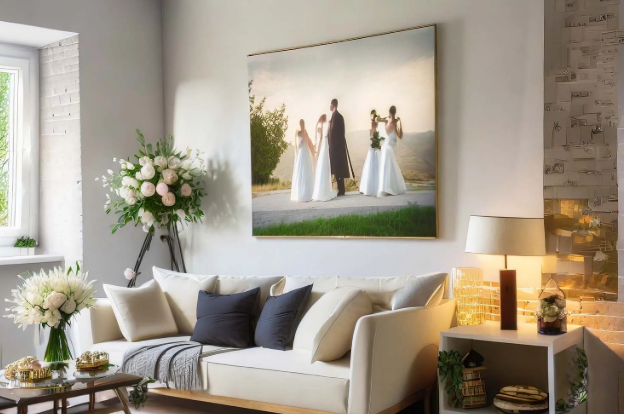
Sometimes, a single large statement piece outperforms a crowded arrangement — particularly above a sofa, bed, or mantel. One oversized image of a meaningful landscape or a candid family moment can function as genuine art in its own right. Viewing distance matters: a piece meant to be seen from across the room should be larger and simpler than one displayed in a reading nook.
Bringing Depth with Objects and Layers
Memory displays gain real dimension when two-dimensional photos are paired with three-dimensional objects. A kitchen shelf might hold framed handwritten family recipes alongside old cooking tools and photographs of shared meals. Shadow boxes can bring together travel souvenirs — maps, small keepsakes, printed tickets — with photos from that same trip.
Leaning frames on shelves rather than hanging everything creates a relaxed, collected feel. Mixing matte and textured surfaces with smooth finishes keeps a display from falling flat. Even a modest collection of memories feels more curated when varied materials and heights are in play.
Preserving Your Memories
Quality materials extend the life of any display. Avoid hanging pieces in direct harsh sunlight or in high-humidity areas without adequate protection. Dust surfaces regularly with a soft, dry cloth, and never spray cleaners directly onto a print or frame.
Equally important: maintain digital backups of every photo you display. Organize files by event or year so future updates stay seamless. After any major milestone — a wedding, a reunion, a significant trip — create a “best of” folder immediately, while the selection process is still fresh. Museum and archival organizations consistently point to proper storage and redundant backups as the foundation of long-term preservation.
Making It Personal
Involve the people who share the space. Let children choose a favorite school or vacation moment. Invite a partner to pick relationship milestones that matter to them. Rotating pieces periodically keeps a display feeling alive and reinforces a shared sense of home. Memory-based decor naturally invites conversation — a travel photo, an heirloom, or a displayed letter gives guests something to ask about and gives you something worth telling. Small handwritten captions near certain pieces — a date, a place, or a brief anecdote — add a layer of intimacy that no purchased art can replicate.
Bringing It All Together
Thoughtful selection, intentional design, and quality materials are what separate a meaningful memory display from a scattered collection of photos. There’s no single correct approach — what matters is that the space genuinely reflects the people in it. Start with one wall or one room, identify the story you want it to tell, and experiment with a single layout before expanding. When memories move from storage boxes and hard drives onto your walls, they stop being distant moments and become a living part of your everyday life.
